She started off anonymously, but as Jamie Watts kept going, more and more people noticed what she was achieving.
“No one was ever supposed to see me.”


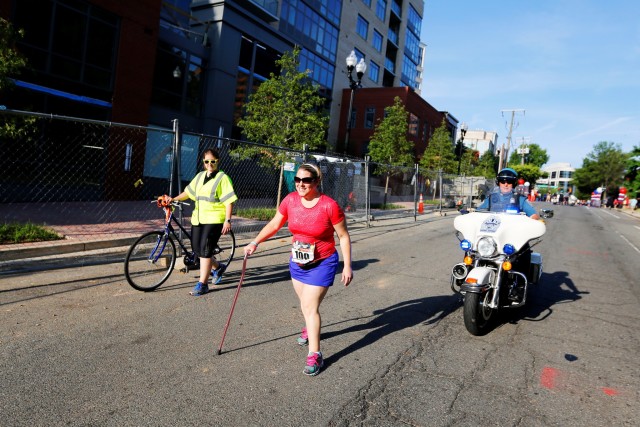
She started off anonymously, but as Jamie Watts kept going, more and more people noticed what she was achieving.
“No one was ever supposed to see me.”

Racing down the final downhill straightaway in first place, with a strong finishing kick, Tyreece Huff was the picture of confidence. Even on a hilly course at Fort Dupont Park, with “brutal hills on the backstretch,” Huff was not fazed. “This course is like a backyard to me. I train here,” he said. “And I love hills.”
He proved his point, running a 17:42 on the rolling 5k course at the third annual D.C. State High School Cross Championships, winning with a wide lead over second place Jake Gosselin of Sidwell Friends School in 18:01.
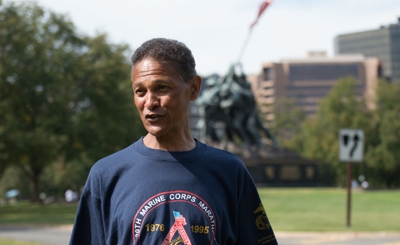
To pin a label on George Banker, you’d have to get him to slow down first.
He’s a runner, an organizer, a historian, a photographer, a speaker, a joker, a mentor, a problem solver, and whatever else anyone needs him to be.

Throughout his 20 year career in the Army, Jeremy Rausa has learned how to deal with challenges. Multiple deployments – to Iraq, Korea, and Germany – meant he had to be away for long stretches from his daughter Adriana, now seven. A passion for running helped him stay fit, and he found it helped him integrate more easily into new communities as he transferred from place to place.
He has always felt a debt of gratitude for the Army and an obligation to give back to his fellow service members. He’s showing this gratitude in a big way in September when he sets out to run 185 miles in seven days (approximately 26 miles per day) along the C&O Canal Towpath to raise funds and awareness for wounded warriors, in a mission known as 185 for Heroes.
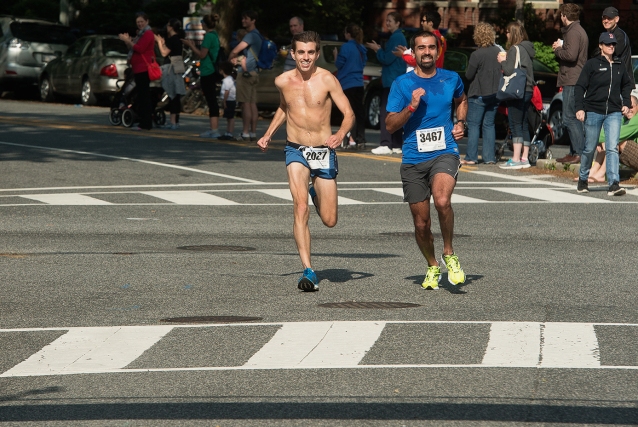
Perhaps she was getting her legs back under her, 10 months after having a baby. It might have been the adrenaline that came from not being able to find her bib and almost missing the start. Maybe runners just don’t forget how to race.
Whatever it was, it worked for Lindsay Wilkins, who won the Capitol Hill Classic 10k May 18 in 37:38. Earlier in the year, she had finished third at the Four Courts Four Miler. The race is an annual fundraiser for the Capitol Hill Cluster School and starts and finishes at Stanton Park, after a run out to RKF Stadium on East Capitol Street. The event yielded almost $80,000.

Finish lines, pacing and water stops.
Colored powder, costumes and glo sticks.
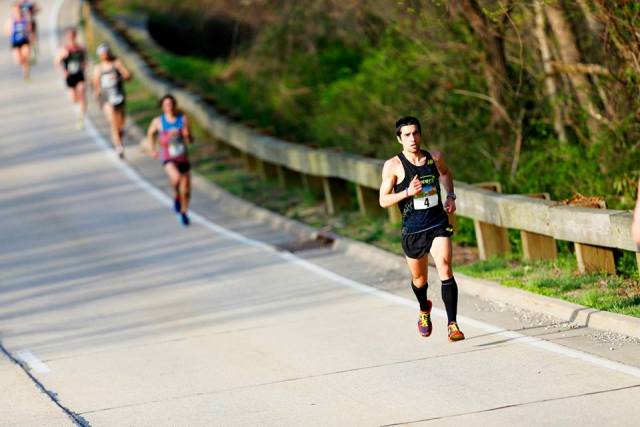
The George Washington Parkway Classic kicked off its 30th running with a shady 10k before a long, sunny stretch that didn’t slow winner Dereje Deme, whose 49:46 was the first sub-50 time in three years, or Claire Hallissey, who is in the middle of a farewell tour of D.C.’s races.
Though the temperature rose considerably in the latter stages of the race, both winners ran negative splits over the second half of the course, despite a considerable downhill in the first few miles as runners left Mount Vernon for Old Town Alexandria.
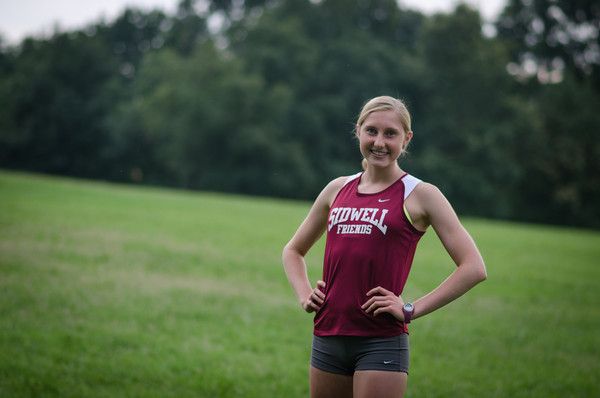
Megan Wilson didn’t start high school planning to run cross country. In fact, she spent her first two years at Sidwell Friends School in the District playing club volleyball. Though she comes from a running family – her father ran at Columbia and her mom at Villanova- Megan had other interests and didn’t feel pressured by her parents to follow in their footsteps. By the start of her junior year, however, she decided to join the cross country team, in part because of her close relationship with coach Gaby Grebski and the team’s strong camaraderie.
[button-red url=”http://www.runwashington.com/2013/12/16/runwashington-high-school-cross-country-team/” target=”_self” position=”left”] More of the All-RunWashington team [/button-red] Despite her relatively late start to the sport, Wilson had an outstanding debut season in 2012, winning the DC. .State Athletic Association championships by over two minutes and placing third in the IAC/ISL/MAC championships. She improved upon those performances this year, winning the Lake Forrest Invitational, the D.C. state meet and the Maryland/D.C. Private School championships. She looks to continue her strong showing in outdoor track this spring before taking her performances to the next level and competing next year for Stanford.

Scaling the final steep hill towards the finish line of the D.C. State High School Cross Country Championships at Fort Dupont Park in Washington D.C., Georgetown Day School teammates Tristan Colaizzi and Aiden Pillard impulsively decided to finish the race together, hand in hand. Having trained and raced side by side all season, often finishing within seconds of each other, made racing down the final straight away together at the DC championship meet even more special. Though they finished with an identical time of 17:34 for the 5k race, Pillard, a junior, was officially declared the winner, and later MVP of the boys race. Colaizzi, a sophomore, was happy for Pillard and with his own performance, saying, “It hurt, but it hurt good, and there’s nothing better than running next to teammates.”

When Amanda Garzon was making preparations to host the third annual Hydrocephalus Association 5k Run/Walk on September 29, she knew that many of the runners participating would not have a first- hand knowledge, or even an awareness of the disease. Many would be standing on the starting line on the mild Saturday morning in late September mainly because they were searching for a local, flat, and fast 5k race to include in their competition schedule. At the same time, however, Garzon, the Co-Chair of the race and the Director of Media and Marketing for the Hydrocephalus Association (HA), hoped that by drawing local attention to the HA cause, she could raise awareness and build support for finding treatment and a cure for the disease.
Garzon knows all too well about the impact hydrocephalus can have on lives. Her 13-year old daughter, Gabriela, has suffered from the disease since she was a baby, and has had 15 brain surgeries. Hydrocephalus, a condition characterized by the buildup of fluid in the ventricles of the brain, afflicts over one million Americans. Anyone can get hydrocephalus, at any age, and there is no cure. The primary treatment is the implantation of a shunt in the brain, a surgery with a high failure rate requiring repeated revisions.