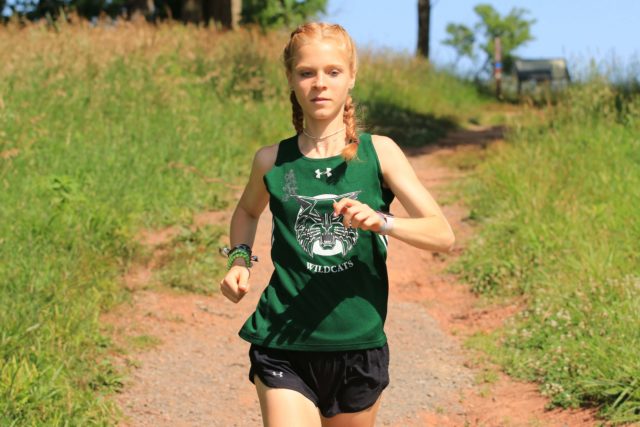
Caroline Alcorta had an even bigger lead than anyone expected. She came into the 2013 Virginia AAA track championships with a 3200 season’s best more than 10 seconds faster than anyone else. And with a half mile to go, she had what West Springfield coach Chris Pellegrini estimated was a 20-second lead.

“I heard people around me saying she had it in the bag, but with that weather, I just wasn’t sure,” he said, more than six years later. 


Last month, exactly 2:34:25 after the starting gun shot into the clear morning sky along Lake Superior, Patrick (“Pat”) Kuhlmann crossed the finish line in Duluth, Minn. to complete his first Grandma’s Marathon ahead of all but three of the master’s division athletes.

The race, famous for its cool late-June weather, fast times, and enthusiastic (and very nice) midwestern hospitality, was run by 6,367 marathoners from all 50 states and 46 countries. Of those, Kuhlmann beat out over 96% of his competitors in the overall men’s division, placing 118th. And in the men’s master’s field–at the age of 48 he is an experienced competitor–he crossed the line 4th out of 289 male masters athletes.


Marathoning remains popular among D.C. area runners, but the number of domestic marathon finishes dropped 7.5 percent in 2018, down to 12,981 from 14,044 in 2017.

At the same time, the number of those marathons dropped to 686 in 2018 from 704 in 2017. As you would expect, the Marine Corps Marathon topped the list with 5,053 local finishers. On the other end, 400 races had no local runners, while 67 had just one. There were likely more, but 147 races did not report the residences of their finishers, many of which were smaller races far from the D.C. area.


Her athletes are not making headlines or standing on any podiums, but that doesn’t stop Burke’s Kareen Lawson from coaching. With dozens of athletes in the Potomac River Running “Burke Beasts” group under her wing, Lawson is making a difference for athletes of all ages and abilities, with an affinity for the over-40 crowd.

Unlike a lot of runners who started running in high school, Lawson started running as a way to meet friends in her 30s. Until that point, she knew most of her friends through her kids. But when her youngest kid left for college in 2012, she found herself wondering how to make new friends. When a Facebook connection referred her to a training program, Lawson decided that joining the program was a perfect way to make new friends while also losing some weight at the same time.


When I got to the D.C. Road Runners Track Championship at Dunbar High School, the final meet in the Eastern Track League series, the women’s masters mile was starting. 

As a high school runner, I race from September to June. These weeks in between seasons are for following dramatic professional races and the pursuit of record breaking performances. My morning routine now consists of checking Twitter to see which all-time mark went down or which finishing kick dazzled the day before.  


Willy Fink came into Saturday’s D.C. Road Runners Track Championship wanting to accomplish something great. He accomplished something monumental.

Competing in a heat with nine runners who had previously broken the four minute mile barrier, Fink led from wire to wire at D.C.’s Dunbar High School and ran the first sub-four minute track mile recorded on D.C. soil (3:58.84). The race had its share of drama, however. Instead of the quick pace many spectators and athletes anticipated, the field started off conservatively and kept the audience in suspense as to whether the four-minute barrier would actually be broken.


Springfield resident Roy Englert, 96, ran 42:20.33 to shatter the 5k world record for men 95-99 at the USATF Masters Outdoor Championships July 11 in Ames, Iowa. The previous record was 50:10.56.

This article was initially published in June 2018.


You can hear it bellowing from speakers as soon as you arrive at a race: directions to gear check, instructions to get into corrals and details about the race course. And when you finish: encouragement, commentary and pleas to keep moving beyond the finish line.

Race announcers play a huge role in running events — from keeping the race-day timeline to interacting with spectators and informing and encouraging participants. And there are scores of D.C.-area announcers who dedicate their weekends to help make races run smoothly and see that runners have fun and feel a sense of accomplishment no matter their finish time.


Even as the number of male American milers to hit that mark approaches 550, a sub-four-minute mile is still a middle distance runner’s milestone, bolstered by the stark difference between 3:59.99 and 4:00.00. For the 65 years men have been running sub-four miles, nobody has done it in Washington, D.C.

With a loaded field, that may change July 13 at the D.C. Road Runners Track Championship, when the race’s momentum, a national developmental effort and new track league converge at Dunbar High School. Eight men entered in the mile have broken 4:00, with Trevor Dunbar’s 3:55.54 PR leading the way. A field of more than a dozen women will race the 1,500 meters, several chasing the world championships qualifying standard of 4:06.50. Elinor Purrier (4:02.34) and Shannon Osika (4:06.17) have met the standard, with four more runners within two seconds. Abbey D’Agostino Cooper, a 2016 Olympian at 5,000 meters, is a late entry. Georgetown alumna Katrina Coogan and Lake Braddock alumna Katy Kunc will race in the elite field.


View More Stories